
AI vs Human Creativity: What AI Can Really Do
Explore how AI generates ideas, where human creativity still leads, and what collaboration means for art, writing, design, and innovation.
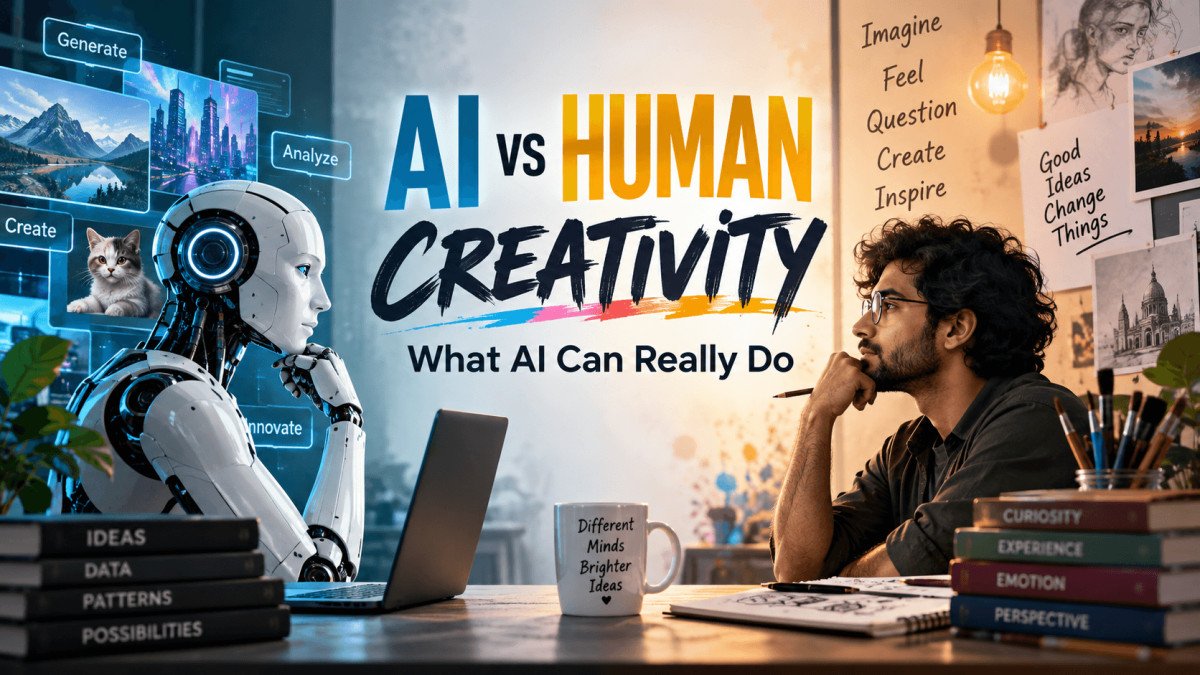
Artificial intelligence has moved from the margins of technical research into the center of creative work. It writes marketing copy, generates images, composes music, suggests product names, edits video, and helps teams brainstorm faster than ever. That rapid progress has triggered an obvious question: if machines can produce paintings, poems, logos, scripts, and songs, what exactly remains uniquely human about creativity?
The answer is more nuanced than either extreme view suggests. AI is neither a magical replacement for imagination nor a useless imitation machine. It is a powerful pattern engine that can simulate many outputs associated with creative work, often at impressive speed and scale. But creativity is not just output. It also involves intention, taste, lived experience, cultural awareness, emotional risk, ethical judgment, and the ability to decide what matters in the first place. That is where the comparison between AI and human creativity becomes most important.
To understand what AI can actually do, it helps to move beyond hype. The real issue is not whether AI can make something that looks creative. It often can. The deeper issue is whether AI can originate meaning, form genuine intent, understand context in a human sense, and create with responsibility. In practice, AI excels at certain layers of creativity and struggles with others. The most productive future is likely not AI versus humans, but AI with humans, where each contributes different strengths.
What AI is doing when it creates
When people say AI creates, they usually mean a generative system has produced new text, images, audio, code, or video based on patterns learned from enormous datasets. These systems do not imagine in the human sense. They do not reflect on childhood memories, wrestle with identity, or experience joy, grief, embarrassment, desire, or wonder. Instead, they analyze relationships within data and generate probable outputs that fit a prompt, style, or objective.
That does not make the result trivial. Pattern recognition at scale can be astonishingly effective. An AI image model can blend visual styles in seconds. A writing model can draft a campaign concept in multiple tones. A music generator can produce background tracks tailored to mood, genre, and duration. In commercial settings, that capability is valuable because many creative tasks involve recombination, variation, formatting, and iteration. AI can do these quickly, consistently, and at low marginal cost.
In other words, AI is especially strong at synthetic creativity: combining existing conventions, references, and structures into something that feels fresh enough for a purpose. It can offer ten headline variations, twenty logo directions, or a hundred social captions long before a human team would finish its first round. That speed changes workflows dramatically.
Still, speed should not be confused with depth. AI does not know why a certain image feels haunting in a historical context or why a phrase carries emotional weight for a specific community unless those associations are represented in its training patterns and the prompt steers it effectively. It can approximate significance, but approximation is not the same as understanding.
Where AI performs surprisingly well
AI has already proven useful across a wide range of creative functions, especially when the goal is efficiency, variation, or support rather than singular artistic vision. In many industries, its strongest role is not replacing creators but accelerating the less glamorous parts of the process.
- Idea generation: AI is effective at brainstorming angles, themes, titles, hooks, outlines, and concept variations. It can break creative gridlock by offering options that a team can refine.
- Drafting and prototyping: Writers, designers, and marketers can use AI to create first drafts, mockups, storyboards, wireframes, and rough concepts quickly.
- Style adaptation: AI can rewrite or redesign material for different audiences, platforms, or tones, which is useful in content production and brand localization.
- Pattern-based production: Repetitive creative tasks such as product descriptions, ad variants, email subject lines, and social media copy are well suited to AI assistance.
- Technical augmentation: In music, film, design, and game development, AI can help with editing, color matching, background generation, sound cleanup, subtitle creation, and other production tasks.
These strengths matter because much of professional creative work is constrained by deadlines, budgets, brand rules, platform requirements, and testing needs. A human creative director may have the vision, but AI can help generate the volume of variations required for modern digital channels. In that sense, AI is not only a creator. It is also a multiplier.
Where human creativity still leads
Human creativity is not merely the ability to produce novelty. It is the ability to create meaning under conditions of uncertainty. Humans make choices informed by memory, embodiment, values, relationships, and social reality. A person can create against convention, not just within it. A person can reject what is statistically likely in favor of what is emotionally true, morally urgent, or culturally disruptive.
This is why the best human work often feels difficult to reduce to a prompt. It emerges from tension, contradiction, obsession, vulnerability, and perspective. A novelist may shape a story around grief not because it fits a pattern but because it expresses something unresolved. A designer may intentionally break visual harmony to create discomfort and provoke reflection. A comedian may use timing and subtext rooted in a specific audience's shared experience. These are not just formal choices. They are acts of judgment.
Human creators also understand consequences in a richer way. They can ask questions AI cannot truly own: Should this story be told? Who benefits from this image? Does this campaign reinforce a harmful stereotype? Is this design ethical, accessible, and culturally responsible? AI can be prompted to flag risks, but it does not bear responsibility. People do.
That distinction becomes critical in journalism, education, advertising, entertainment, and public communication, where creative output can shape beliefs and behavior. Creativity at a high level is inseparable from accountability.
The difference between originality and recombination
One of the biggest misunderstandings in the AI creativity debate is the assumption that human creativity is pure originality while AI is pure remix. In reality, both humans and machines build from prior influences. Every artist, writer, musician, and inventor learns through exposure, imitation, and transformation. No creator works in a vacuum.
The difference lies in how influences are integrated. Humans do not just recombine references mechanically. They filter them through consciousness, identity, intention, and experience. A filmmaker inspired by earlier directors may still produce something deeply personal because the work reflects a distinct worldview. AI, by contrast, does not have a worldview. It can generate convincing combinations, but it does not hold beliefs, memories, or stakes in the outcome.
This does not mean AI-generated work is always shallow. Sometimes recombination is enough. A practical business article, a clean interface concept, or a background music track may not require profound personal vision. But in work where authenticity, voice, and cultural resonance matter, the absence of lived experience becomes more visible.
That is often why AI output can feel polished yet strangely generic. It may be technically competent but emotionally flat, coherent but not memorable, inventive in surface detail but predictable in deeper structure. Human creators often recognize this immediately: the work says something, but not because it has something to say.
Creativity is more than generation
Much of the public conversation focuses on generation because it is the most visible feature of AI. You type a prompt, and a result appears. But professional creativity involves far more than producing material. It includes defining the problem, setting constraints, selecting references, identifying audience needs, shaping narrative logic, editing ruthlessly, and deciding what to keep out.
This broader process helps explain why AI can be both impressive and limited at the same time. It can generate many possibilities, but it does not independently know which possibility serves a long-term brand strategy, which line best captures a founder's voice, or which visual metaphor will resonate in a politically sensitive market. Those decisions require context and judgment beyond pattern completion.
In many workflows, the highest-value creative act is not making more options. It is choosing the right option. Curation, sequencing, framing, and refinement are deeply human strengths. The more content AI can produce, the more important those strengths become.
What this means for writers, artists, and designers
For creative professionals, AI is best understood as a tool with uneven capabilities. It can remove friction, but it can also introduce sameness if used carelessly. A writer who relies on AI for every draft may gain speed while losing voice. A designer who uses AI image generation without a clear concept may produce attractive visuals with weak strategic relevance. A marketer who automates content at scale may increase output while reducing trust if the material becomes repetitive or generic.
The professionals who benefit most from AI are usually those who already understand their craft. They know how to prompt with specificity, evaluate quality, spot clichés, and reshape outputs into something purposeful. They use AI to extend their process, not replace their thinking.
- Use AI for divergence: Generate multiple directions quickly when exploring ideas.
- Apply human judgment for convergence: Select, refine, and align ideas with goals, audience, and ethics.
- Protect voice and intent: Let AI assist with structure or variation, but keep core messaging and final tone under human control.
- Treat output as raw material: The first AI result is rarely the final creative answer.
- Build originality through perspective: What makes work distinctive is often the human angle added after generation.
This approach turns AI from a shortcut into a collaborator. It also reduces the risk of producing content that feels interchangeable with everything else generated from similar prompts.
The business case for AI creativity
From a business perspective, AI's appeal is obvious. It lowers production costs, speeds campaign development, supports personalization, and expands experimentation. Brands can test more ad variants, create localized assets faster, and maintain content pipelines with smaller teams. For startups and lean organizations, that can be transformative.
Yet scale creates its own problem: abundance reduces differentiation. If every company uses similar tools to produce similar content patterns, then the competitive advantage shifts away from mere production and toward strategy, brand distinctiveness, and trust. The companies that stand out will not be those that generate the most material, but those that combine AI efficiency with strong editorial standards and a recognizable point of view.
That has implications for hiring as well. The future likely favors creative professionals who can do three things at once: understand audience psychology, direct AI systems effectively, and exercise refined taste. Technical fluency will matter, but so will human depth. The market will reward people who can turn machine-generated abundance into coherent, meaningful communication.
Ethics, ownership, and cultural concerns
No serious discussion of AI creativity is complete without addressing ethics. Generative systems are trained on vast amounts of existing material, raising questions about consent, attribution, compensation, and intellectual property. Artists and writers have legitimate concerns about models learning from their work without clear permission or payment. Even when outputs are legally defensible, the moral debate remains unsettled.
There are also concerns about bias and cultural flattening. AI systems often reflect dominant patterns in their training data, which can reproduce stereotypes, overlook minority perspectives, or favor familiar aesthetics over local nuance. In creative industries, this can lead to homogenized output that appears diverse on the surface but lacks genuine cultural specificity.
Human oversight is essential here. Teams using AI need standards for source integrity, fairness, disclosure, and review. They must ask not only whether AI can produce an asset, but whether it should, under what conditions, and with whose interests in mind. Responsible creativity requires governance, not just generation.
So, what can AI actually do?
AI can generate text, images, music, video, and concepts that are often useful, sometimes impressive, and occasionally remarkable. It can accelerate brainstorming, automate repetitive creative tasks, support rapid prototyping, and help professionals explore a larger possibility space. It can mimic styles, synthesize references, and adapt content for different channels. In many practical contexts, that is more than enough to create real value.
What AI cannot truly do is possess intention, consciousness, lived experience, or moral responsibility. It does not care whether a story heals or harms. It does not know what it means to risk failure for the sake of saying something necessary. It does not have a self to express. These are not small limitations. They define the boundary between generated output and human creativity in its fullest sense.
The most realistic conclusion is that AI is changing creative work without eliminating the need for creators. It is strongest as an amplifier of process, not a substitute for perspective. It can help make, but it cannot decide what is worth making in the deepest human sense. That decision still belongs to people.
As AI tools continue to improve, the central challenge will not be defending a romantic myth that machines can never produce compelling art. They already can, at least in some forms and contexts. The real challenge is preserving the human capacities that give creative work meaning: judgment, empathy, originality of perspective, cultural awareness, and the courage to create something that is not just optimized, but true.
In that future, the winning question is not whether AI will defeat human creativity. It is whether humans will use AI to produce more noise or more value. The technology is powerful. The purpose behind it remains our responsibility.
What's Your Reaction?
 Like
1
Like
1
 Dislike
0
Dislike
0
 Love
0
Love
0
 Funny
0
Funny
0
 Wow
0
Wow
0
 Sad
0
Sad
0
 Angry
0
Angry
0








Comments (0)